We live in a world where coding, making, and even distributing games is becoming increasingly easy. Making indie games has never been easier. There is extensive education about them. Given that we’re a platform for vibe-coding games, it makes sense that we provide helpful information for people who are curious about or interested in making their own games.
Note before you go further:
While the title of this blog says “The 5 Elements That Make A Successful Indie Game,” it is NOT really about Indie games. Pikoo is a game-creation app that lets anyone make games. They may not distribute it to the general public and instead want to make something for their friends, family, students, colleagues, or another cause. But the thing is, the rules for making a good indie game are largely similar to those for making a game your friends would want to play.
In fact, if I were to title the blog, I would have titled it “What are the 5 things elements that would make my friends play my game,” but there is something about SEO and whatnots that we have to keep the title this way. Let’s go.
- Strong Hook:
- Tight gameplay loop:
- Great story:
- Clean Identity:
- Community and Shareability:
- Bonus: Completeness!
1. Strong hook:
There is a concept of the right balance between novelty and familiarity. You cannot be too absurd or novel to get attention. But also don’t want to be too familiar. You want to be within the appropriate range. A generally good hack for getting to something juicy is thinking in terms of X but Y. Say, GTA but set in Egypt. Call of Duty, but in 2D top-down. And so on. If you’re making for a particular audience, say, people who like to do Crocheting, then you can make something as simple and classic asthe classic snake game, but for crocheting. Trust me, your crocheting friends will absolutely love it!
2. Tight gameplay and a solid core loop are essential. A core loop is typically:
x is the situation; the player does y; y results in victory; the player can then do y + z; and x + a is the situation. This circular loop is what repeats in almost every game. You need a clear and robust core loop for your players to engage with your game.
The overall gameplay is markedly different. Big triple-A games are bought by patient players who are willing to spend some time getting to know the game and setting it up. On several occasions, it is because players have invested significant money and resources to play the games in the first place. But most indie games do NOT have that luxury. Indie games have to have a very tight gameplay loop. This does NOT necessarily mean that you’re flashing lights and making casino sounds every 2 seconds but you do need to figure out a reward structure for your players to want to play further.
Let me show you, with the help of a diagram that Will Wright used in his masterclass for game design. Shh. Don’t tell anyone I’m using it.
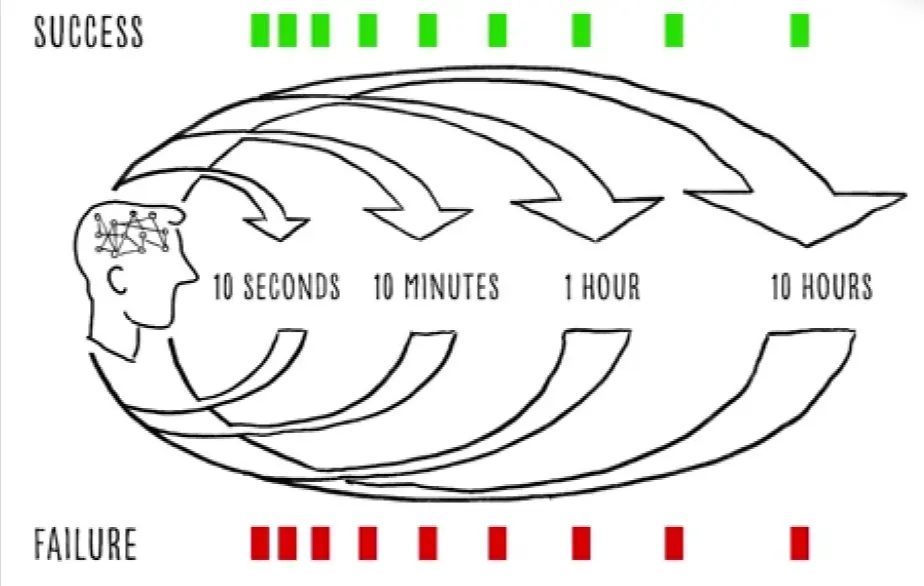
This diagram shows the success and failure loops. You want your participants to experience some successes and some failures at approximately 10 seconds. From their accomplishments, they should gain additional capabilities, increasing the challenge for the next minute. From the failures, they should learn something about what to do and what not to do in the game to get further. Then, similar loops should be planted at 1-minute, 10-minute, and subsequent intervals.
Try to think tiny loops for if you’re making games for your friends and family. To set some context, I made a game on a topic that my dad is pretty interested in, and he got bored of a game after trying it for 50 seconds because he failed. And he sort of passed on the game. That’s how ruthless your friends and family can be. Side note: do not judge my dad.
3. Great Story:
If you ever read the book “A theory of Game Design” you’ll understand that story of a game is very dear to a player. A game is a simulation. The player should want to live the simulation that you’re creating. The simulation can be a fantasy RPG or something as simple as simulations of real-life situations in the lives of care workers. It can even be a story of the hike you went on. It just needs to have a story that your friends would want to experience once and preferably again and again.
4. Clean Identity:
This is where you should find a bit of your own voice. This can take the form of sounds, images, artistic styles, or commentaries. Anything. But you want to add something to your game that your audience will be able to identify as yours. This increases the recall value of your game. Speaking in terms of making the game for your friends… think internal jokes and memes. Think the drawings you made. Or poems you wrote. Or even the science project you created. All of these are great grounds of identity. For indie games, it is typically the art styles. But when the world opens to everyone… I feel like there will be numerous ways that people will find to add identity. I feel optimistically clueless on this one.
5. Community and sharability:
This is absolutely important but I want you to still think of it a little later in your game design and game development journey. This is the part of your game that makes it relatable and brings that feeling of “I want to show this to my friends. This can be for any reason. Let’s say you made a game for kids to be able to complete a quiz, the kids may simply want to show their score to their friends and parents. For your friends, if you made a game that brings your memories to life, then a friend may want to show it to other friends or even their partners or kids. You want to include at least a little something that will allow your players to bring in more players.
For indie games, the community component typically aims to generate buzz around the game before its release. It also helps creators to do early beta releases and get a lot of feedback to iterate. These are also great reasons to include community and shareability.
6. Bonus: Completeness!
Dear you, a shitty complete and shared game is significantly better than a master plan lying around in some dead folder. Send the game you made to your friends. Hear their feedback. Try to make the same game better OR make a new one.
Pikoo.ai is here to help you make your games! Check it out!
Leave a Reply