Author: Pikoo

  • Kids Don’t Just Play Games, They Can Make Them

    Kids Don’t Just Play Games, They Can Make Them

    “Kids don’t just play games; they can make them.” How is this even a topic of discussion? Kids make games all the time. Have you seen a preschooler or a young child around? I am not talking about toys or games. I am talking about anything. Any household object that you may intentionally or unintentionally leave behind, not even in the hands of the kid, but around the kid. Come back 10 minutes later, and unless the kid has found a way to injure themselves with it, they would have found a way to play with it.

    And if you have the patience to be an audience, go and ask them what game they are playing. Boy, are you in for a ride! They’ll tell you the most amazing backstory for the evil piece of cardboard and how the wooden bowl has come from the farthest end of the universe to protect the land of erasers and spoons. And how only they know how the bowl needs to dance and shoot caps of bottles to strike the cardboard villain, so that it has to go back to its cave.

    And, if you let them play this out, and you’re still interested and present as the audience of their games, you’ll see that the evil cardboard villain has gone and made friends with the plastic bottles. This alliance is now too powerful for the kid to defend alone.

    And if you’re still patient and present my friend, before you even know it, you’re a player of the game. You’re suddenly responsible for training and leading the eraser army. Your moves are being tracked by the kid and as you do things wrong, your team loses the game and you have to start again. And again. And again. Until one of the three things happen… you get it right. Your patient runs out. Or the kid gets hungry(or sleepy).

    With this superlong prelude, I request you not to imagine the state of my living room but get the point. Kids don’t just play games. They literally make them.

    From Imagination to Video Games

    As we grow up, the games start to change. Maybe when my teammate suggested this topic, he meant that kids don’t just play video games, they can make them. Ah! That makes more sense. We can talk about Pikoo on that topic. Well, let’s break this one down into parts:

    1. Do kids play games?
    2. Can kids make games?
    3. Do kids play video games?
    4. Can kids make video games?
    5. How can kids make video games?

    In a slightly ironic twist, of these 5 parts, I have already explained parts 1 and 2. And with a $300 billion industry based on video games whose primary consumers are children, part 3 requires little to no justification. Let’s turn our attention to parts 4 and 5. Can kids make video games? If so, how can children make video games?

    Can Kids Make Video Games?

    Well, kids can make video games. In fact, Scratch– the programming language that came from MIT used making video games as one of the ways to excite kids about and teach programming to millions of kids. There are other examples of global products, such as Roblox and Minecraft, where kids can create games. However, there is a subtle difference between “kids” and “kids who love programming.” All these platforms require programming skills. If children learn programming, they can create games. At Pikoo, we’re building a platform where kids can create games without programming knowledge. Any idea can be just written down and turned into a fully playable video game.

    Pikoo is a platform for kids to vibe-code games. They can simply come up with an idea, write it down and tell Pikoo.ai to turn it into a fully playable game. Pikoo’s text to game AI will make a game for them. But it doesn’t just stop there. They can further chat with Pikoo’s AI Game Creator to edit the game to their satisfaction. It is no longer an isolating activity. Since your game is instantly playable, you can share it with your friends and family. You can get feedback from them. You can even collaborate with them to make your game better. The brave ones can go one step further and apply for Pikoo’s template creators program, where you can push your game in the form of a template to allow anyone to re-use your game as a starting point or a skinnable object.

    To answer the simple question: How can kids make video games? Just go to pikoo.ai.
  • A Complete Guide to Creating AI-Powered Storytelling Games on Pikoo

    A Complete Guide to Creating AI-Powered Storytelling Games on Pikoo

    How are stories and games related?

    Most uninitiated minds would see these two as completely different spaces. The interesting and ironic thing is that they’re extremely related. In fact, an argument can be made that stories are just documented games. Stories have a fixed beginning, middle, and end for every reader or listener. And games are nothing but stories whose beginnings, middles, and ends can differ for different people. Players’ actions in the games can change these.

    That’s how we see games. Did you know that historically, games and play predate stories? That’s because there is a literal biological need for play. Anyway, I digress; you can consult Brian Boyd’s book “On the Origin of Stories” (solid alliteration there:) if you want to go deeper into this. For now, we use only documented games.

    So what? Who makes stories from games or games from stories?

    Short answer… everyone! For the slightly long answer, let me tell you the story of an Italian plumber. The plumber falls in love with a princess, but a dangerous villain abducts the princess. Now, the plumber needs to go through a long, perilous journey to save the princess. Do you know which story this is? It is the story of Mario.

    Suppose stories are merely documented games. You need a clear idea, world, or story to make a good game.

    But how do I make good storytelling games?

    No fear, kind Lear. Ask yourself these questions:

    1. Who is my hero?
    2. What do they want?
    3. What’s stopping them?
    4. How do they overcome this?
    5. What did they get?

    Once you have the answers for these questions… ask “How can I represent it? For each question.

    1. Who is my hero? – How can I represent it?
    2. What do they want? – How can I represent it?
    3. What’s stopping them? – How can I represent it?
    4. How do they overcome this? – How can I represent it?
    5. What did they get? – How can I represent it?

    You’d always want to go all in on the details from day 1. But that’s kind of a bad idea. Start small.

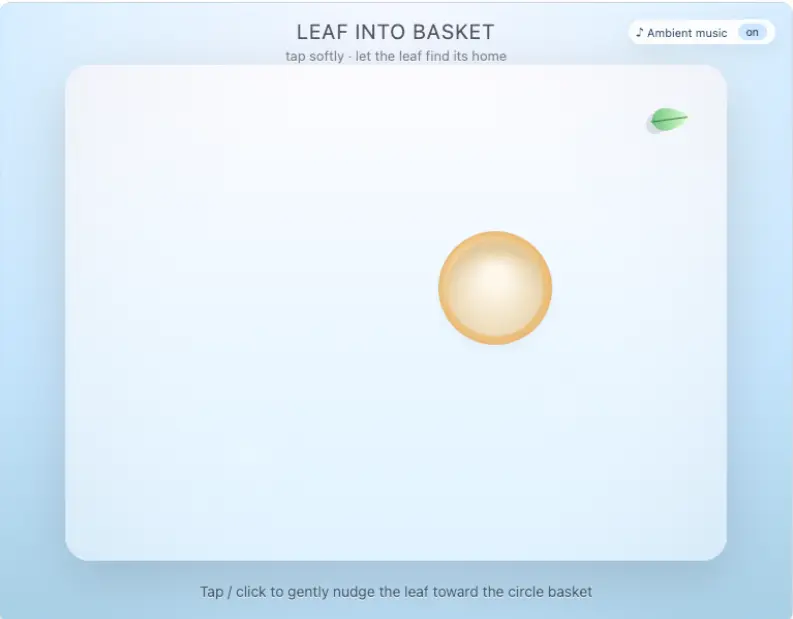
    Let’s try to make a game with AI to tell the story of wild brains and how we can calm them.

    Questions Answers How can I represent it?
    Who is my hero? My mind A leaf
    What do they want? To meditate or relax To get to a circle
    What’s stopping them? The constant hustle-bustle of thoughts and my own constant overthinking No action will drag the leave away. Swift actions will drag the leaf away.
    How do they overcome this? By practicing If I tap gently at a slow speed, which pushes me to take a breath in between, I bring the leaf closer to the circle.
    What did they get? Some reward. A bit quiet. I win when the leaf gets to a circle.

    As soon as we have the answers for all of it, we can make a game on Pikoo. You make the prompt more articulate, but including the details of your representation in the prompt box will yield a fully playable game.

    A leaf is trying to get to a circle.

    No action will drag the leave away. Swift actions will pull the leaf away.

    If I tap gently at a slow speed, which pushes me to take a breath in between, I bring the leaf closer to the circle.

    I win when the leaf gets to a circle.

    This is literally the prompt that I entered to get me the game:

    leaf into basket

    We have done this using a single example. You can try more such things yourself on Pikoo.ai

    A few things to keep in mind:

    1. Start with simple ideas and stories
    2. Simplify the representations as well
    3. Keep the prompt focused on the representation component, as it may become confusing to combine the story and the representation.
    4. It will take more than a few attempts to start getting it right.

    This is an effortless way to make your storytelling games with Pikoo.ai

    Even the most proficient, prompt engineers take some time learning how to vibe code things. AI as a technology is relatively new so that you may feel some frustration at the beginning, but once you get the hang of it, you’ll start to see exponential growth. I’d encourage you to try to make at least 10 straightforward games before deciding whether you can make what you can. If you still struggle, please feel free to tell us more about it on our Instagram, TikTok, Reddit, Twitter, or any other social media.

    We look forward to playing the games you make and experiencing the stories you tell!

  • Vibe Coding Games For Educational Purposes

    Vibe Coding Games For Educational Purposes

    Play is a fun way of simulated learning for most animals. Monkeys hang on branches and jump over each other to practice hanging in the jungle while avoiding predators. Lions fight among themselves as they play to learn how to catch prey. The same is true for humans. We love playing as well. We also started with some sports. As our worlds became more complex, we required more sophisticated simulations, such as chess, and our knowledge base grew sufficiently complex that we needed even more sophisticated simulations.

    Today, video games are mostly mental puzzles or very complex simulations of high-order fantasies.

    By reverse-engineering many natural processes, we also reverse-engineered the concept of using games for simulation or learning. Since then, educational and simulation video games have continued to grow, making the learning process more engaging.

    The only problem with developing educational games was that game development was previously complex. Now we’re set to solve this problem. To develop an educational game earlier, you needed a teacher, a programmer, and a designer. Now, however,r with Generative AI and vibe coding, the process of game creation can be shrunk to minutes. An individual teacher can create a game simply by entering a sufficiently detailed text prompt. She can create simulations to explain a concept or pose a problem for students to solve.

    The process of making the core elements of the game with an AI game generator is pretty simple:

    Write down the primary content of the game. Think of a rough mechanics that simulates the game. Write down both these things combined. Answer a few simple questions from the Pikoo.ai agent and voila! Your game is completely ready. You can play it. Test it out for yourself. And further make changes to it. The game is already live as soon as you make it, and you just need to share its link for your students to play it.

    Case Study 1: The math class

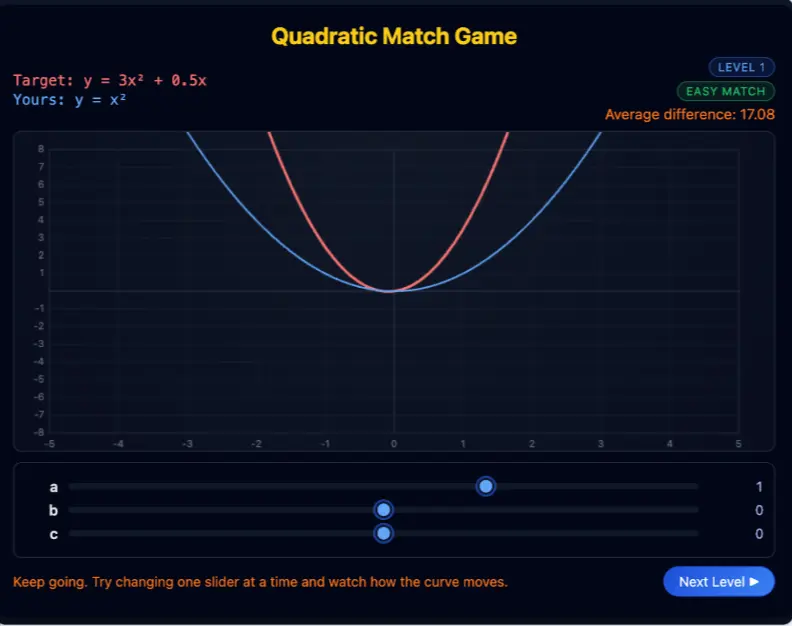
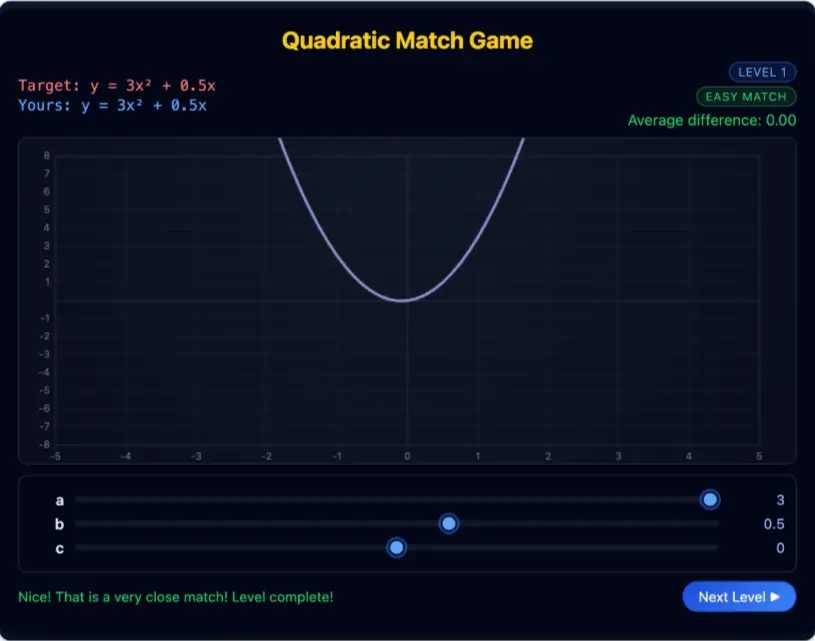
    Irina, a teacher from a Boston school, wanted to conduct a simple simulation of quadratic equations. For the mathematically challenged audience, a quadratic equation is typically y = ax^2 + bx + c, where a is not zero. The graph of this equation is a parabola, or bowl-shaped. Now, Irina did not just want to create a simulation with a few equations and result graphs; she wanted the students to be able to modify the numbers in an equation and see how that changes the graphs. Furthermore, she sought to create a game in which students could test their ability to predict an equation or a rough graph by understanding the patterns that equations and numbers follow. She achieved this by creating a Quadratic Math Game. This is the prompt and conversation she utilized:

    Irina’s prompt:

    Develop a simple graph-based simulation game for quadratic equations.

    System:

    Hi! That idea is excellent – a graph game for quadratics sounds both fun and highly effective in learning math.

    First, I want to understand the game like a friend, then I’ll sketch it with text art, and only when you say “yes, I’ll build the full playable file.

    Let’s start simple with just one question:

    Do you imagine this more like:

    A) “Guess the graph.”

    You see a graph of a parabola, and you have to choose or type the correct equation (like y = x² + 2x + 1)

    B) “Build the graph.”

    You get sliders or keys to change a, b, c in y = ax² + bx + c, and try to match a target parabola (position, shape, etc)

    C) Something else? (Tell me in your own words, like: “I move a point and see the curve change” or “I shoot the correct graph,” etc.)

    Just pick A, B, or describe your own idea.

    Irina’s prompt:

    B

    And the rest is history. With a straightforward prompt and a couple of responses, Irina was able to obtain the desired game. She projected the game on her classroom board and allowed every student to try for a graph. This made for an enjoyable activity for kids and a fulfilling experience for Irina. We are proud to have been able to help.

    quadratic match game

    quadratic match game

    Case Study 2: Learning Game for Careworkers in the UK

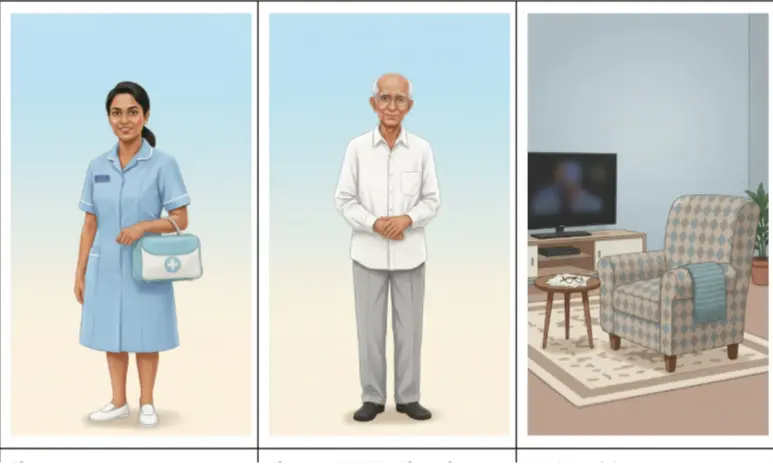
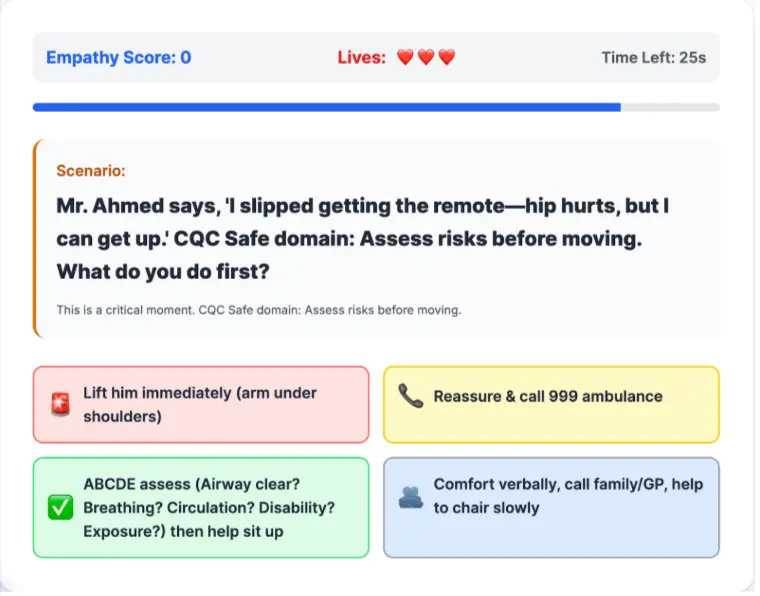
    Amaka, a care worker in the UK, understands that caring for older people is demanding and requires skills. She developed a simulation-based quiz game through which care workers can practice real-life scenarios and improve their skills. Her colleagues are receiving the game well, and she is already developing additional simulations based on the feedback.

    AI Game case study

    scenario

  • How to Make Some Christmas Games on Pikoo

    How to Make Some Christmas Games on Pikoo

    Christmas is right around the corner. While you’re lazing around in the cozy beds, sipping hot chocolate, eating cookies, and planning gifts, there is something fun that you can do for yourself and your family. Pikoo can help you get into the Christmas spirit by creating Christmas-specific games.

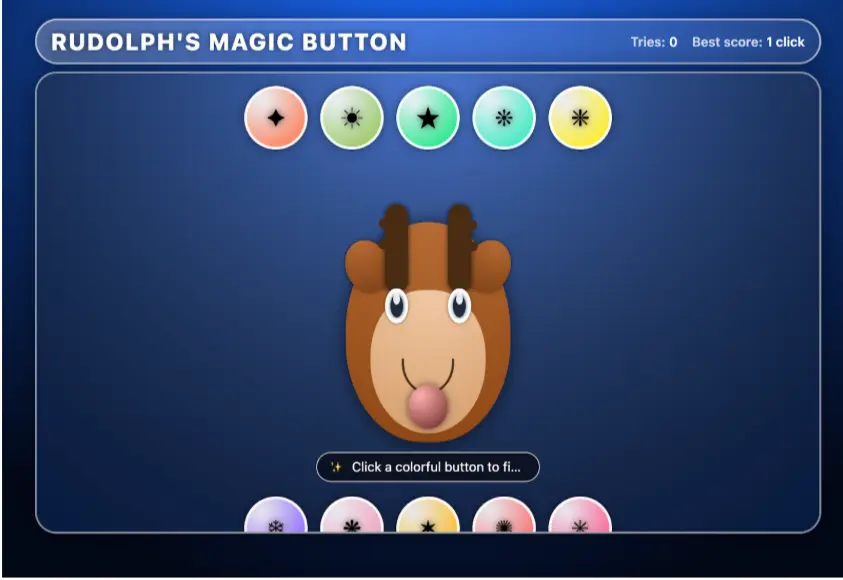
    Let us show you how we created a simple, engaging game for everyone in the family to play with an AI game generator. The rules are simple. There are a few buttons and a large, colorful image of Rudolph the Red-Nosed Reindeer. Of all the buttons, only one lights up the nose of Rudolph and makes him say nice things, and the rest are just mildly snarky remarks. You can press any button until you find the right button. Another way to play it is to pass the mobile phone around the family, and whoever has it presses a button. If they get it right, they take a shot (of hot chocolate); if not, broccoli?

    Steps to create games from text

    So to make this game, I entered the prompt:

    Initial prompt:

    Design a game in which you must find the correct button to illuminate Rudolph the reindeer’s nose. When the nose lights up, Rudolph says nice things. When it’s the wrong button, it’s slightly snarky.

    System’s response:

    Hi! That’s a super cute idea, I love it. Let’s make Rudolph’s nose light up!

    First, let’s figure out the basics together.

    For now, imagine something like this:

    You see Rudolph on the screen

    There are several buttons (or colored circles)

    Only ONE of them is the “magic” button

    When you click the correct one, his red nose lights up, and he may smile, or a message appears, such as “You found it!”

    Let me ask you just one thing to start:

    Do you want it to look more like:

    A – A simple screen with Rudolph and some regular buttons with text (like “Button 1, Button 2, Button 3…”)

    or

    B –  Some colorful shapes or icons (like stars or circles) that you can click to try and find the right one?

    Just answer “A” or “B” (or describe your own idea), and then I’ll show you an ASCII preview of how the game will look!

    My response 1:

    Make it very colorful and bright.

    System’s response:

    Nice! Colorful and bright Rudolph button game coming up 😄

    Let me ask just one simple thing so I get it right:

    Do you imagine the buttons as:

    A – Colorful circles (like red, blue, green, yellow dots)
    B – Fun shapes (stars, hearts, snowflakes, etc.)

    You can just say “A” or “B” (or mix them, like “colorful circles and one star”).

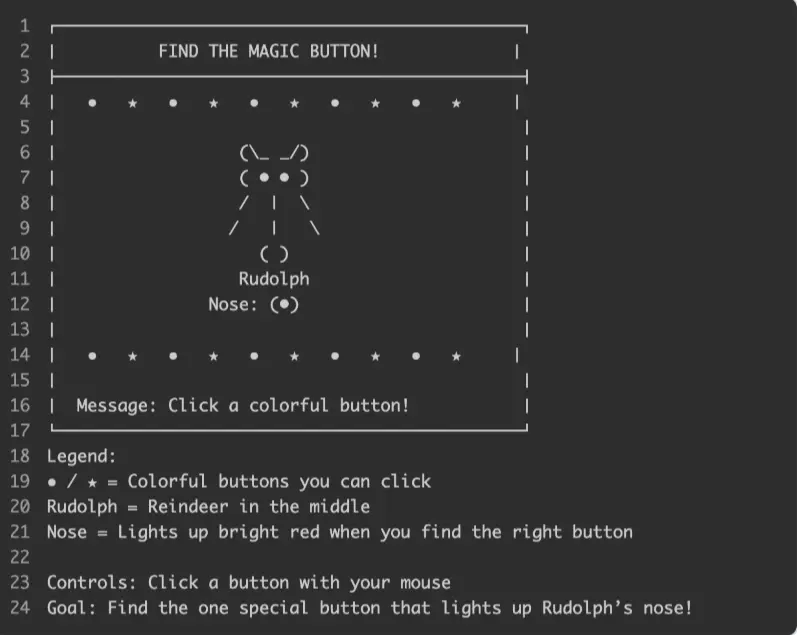
    While you think, here’s a quick preview of what I’m imagining:

    YOUR GAME DESIGN

    What you’ll make:

    A bright, colorful screen with Rudolph in the middle, lots of colorful buttons around, and you have to click to find the one that lights up his nose.

    • The Setup: You control: Your mouse (clicking buttons)
    • Goal: Find the correct button that makes Rudolph’s nose glow bright red
    • Watch out for: Nothing dangerous, but many wrong buttons that just do nothing or say “Try again!”
    • Controls: Click with your mouse or tap on the screen (if on mobile)

    HERE’S YOUR GAME!

    magic button

    Does this look right for you: Rudolph in the center, lots of bright, colorful clickable shapes around him, and one of them lights his nose?

    If yes, just say:

    “looks good” (and tell me A or B for circles vs shapes)

    Then I’ll build the full playable game that you can just open and play.

    My response 2:

    Looks good.

    AND THAT’S IT! That’s all it took to get me the game I wanted. 

    I got this colorful game, which I can literally play with my grandma and my nephew– all on the same table.

    rudolph's magic button

    You can now go to Pikoo and try making different Christmas games yourself. If you’re feeling lazy, here are some example prompts and game screenshots.

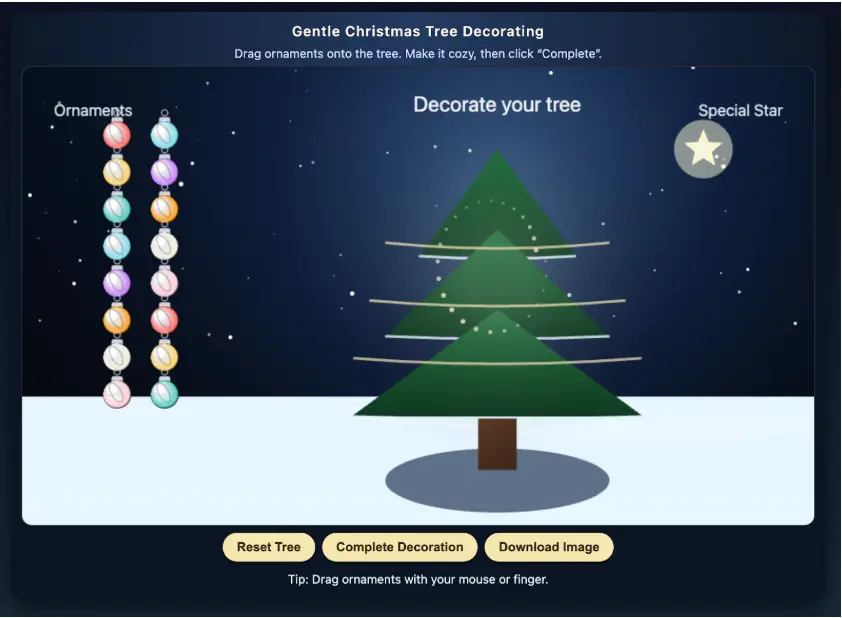
    1. A simple game involving a Christmas tree and a collection of ornaments. You can hang the decorations on the tree. When you press complete, you can share or take a screenshot of the tree image.
    gentle christmas tree decorating

    2. Create a game in which you gently float Santa above the houses and land him on the Chimneys. When you land him on three chimneys, you win and receive a bright, merry Christmas greeting.

    Have fun! Merry Christmas and Happy Holidays!!!

  • Why Do We Make Games?

    Why Do We Make Games?

    We interviewed 100+ users who love making games. These are NOT just professionals but also young individuals who make games on platforms like Roblox and Minecraft. These are curious and highly creative people who we don’t hear about regularly. While “What is wrong with Roblox” is a blog in and of itself, we will keep that for another time. Let’s keep this on why people want to make games:

    1. To make a popular game
    2. To make money
    3. To get the joy of creation
    4. To have fun with games
    5. To express themselves and tell stories
    6. To experiment with game ideas
    7. To challenge themselves and gain mastery
    8. To share games with friends
    9. To learn the basics of game design
    10. To socialize and develop collaboratively
    11. To learn the basics of programming

    Let’s go one by one:

    1. To make a popular game:

    This is the absolute and most common reason we heard from literally everyone. From the very young to the most experienced game developers. Everyone wants to make a game so that many people can play it. The definition of “a lot” varied from 10 people to 10 million people for different people, but the emotion was always about a lot. 

    2. To make money:

    The young kids want to make a career in games, the professionals wish to grow, and the indie developers want to make money by selling their games or copies thereof. 

    3. To get the joy of creation:

    Fame and money are the most common reasons that we want to do anything, but beyond that, creativity is an innate desire. The kids want to make games because they enjoy making games. They enjoy the sandbox nature of building. 

    4. To have fun with games:

    Everyone who makes games just loves games. They also typically love to play their games. 

    5. To express themselves and tell stories:

    We see games as a means of storytelling. And that’s one of the reasons why people make games. They want to make a game about helping older adults, about how their parents help them during camping, or just a cool homework assignment—games as a means of storytelling. 

    6. To experiment with game ideas:

    Kids love sandbox. Experiment with different ideas. Different projects. They want to know what a GTA set in Delhi would look like, or what Subway Surfers would be like if mom is chasing you with milk. Or what would games be if I have very little time to solve a puzzle to understand how to fly a plane.  

    7. To challenge themselves and gain mastery:

    The folks who are a bit more experimental, who have made even a 30-second game in the past using templates or simple languages like Scratch, just enjoy making games like a sport. And they want to do it more to gain mastery over it. 

    8. To share games with friends:

    This is a more personal version of popularity that the users seek. They want to make games that are specific to their friend group. Something akin to internal jokes. 

    9. Learning the basics of game design:

    Users in the 16-24 age bracket have a nuanced understanding of socials, storytelling, and game design as a discipline. For them, making games is another way to learn game design. Quite a few of them have previously watched videos on how to make games, or what game design is, and what level design is. They are always looking for tools and teammates to help test their ideas. 

    10. Socialize and build collaboratively:

    This set of users can be classified as curious nerds. They’re not alone in wanting to experiment with ideas, but they have groups of friends. These groups often take the form of Discord or WhatsApp/Instagram chats. They exchange memes, create them, play some games together, and literally experiment with strategies. They want to have something digital to do together. Some of them have a regular schedule of coming back from school, sitting together on Minecraft, and building their worlds. This group of users wants their ideas to come to life as they hang out on a group chat. 

    11. Learn the basics of programming:

    This was a fascinating observation. Quite a few students or potential users who wanted to get into game design actually had the notion that learning game design meant learning programming. When we dug deeper into their thought process, we found that this perception was a consequence of past trauma from trying to make games or attending coding courses in the name of game design. 

    These are some of the insights we got from interviewing aspiring game designers. We’ll be putting them into a jobs-to-be-done framework and making some comparisons with existing products. We will see which product decisions this shapes up for us and how we define product requirements based on this. Till then, if anyone asks you why kids even want to make a game. You can point them here. 

  • The Next Generation of Content is Game Creation Powered by AI

    The Next Generation of Content is Game Creation Powered by AI

    Game creation is one of the most intimidating creative endeavors we have today.

    The Evolution

    Part of this stems from the relatively recent emergence of video games as a medium. They’ve literally only existed for 40–50 years. That’s nothing compared to writing, music, or visual art. And yet, in that short span of time, games have evolved at an unusually rapid pace, coupled with technological advances across many fields.

    To make even a reasonably good game today, you need to navigate multiple digital disciplines at once. Graphic design. UI. Animation. Sound design. Programming. Game mechanics. Player psychology. Level design. Distribution. Each of these fields evolves independently, and an innovation in any of them can suddenly shift what’s possible and who gets to make it happen. The frequency of these advances is every few weeks.

    The result is predictable.

    The Change

    Almost no one has enough skills to make great games entirely on their own. Very few people have sufficient clarity, confidence, or access to resources to conceptualize a game and assemble the right team to bring it to life. Game creation can feel inaccessible, even to people who deeply love games.

    In that sense, game creation today looks a lot like video creation did in the early 2000s.

    In the past, making a video required expensive equipment, specialized software, and technical expertise. Most people were consumers, and a select few were creators. The desire to create existed, but the barriers were too high. Over time, that changed because technology advanced and reduced the cost of experimentation.

    This is a pattern we’ve seen repeatedly.

    When the internet became mainstream in the early 90s, it democratized text. Publishing shifted from institutions to individuals with access to a computer. Digital cameras and tools like Photoshop did the same for images. Smartphones with high-quality cameras and enough storage did it for video. Each time, a new content format emerged alongside existing ones, slightly reshaped behavior, and participation occurred at unprecedented scales.

    Games are next.

    The Future 

    Generative AI is the technological shift that enables this. While it entered the public imagination roughly four or five years ago, it’s only now reaching a point where real, practical use cases are coming together. The tools are becoming reliable enough, fast enough, and flexible enough to assist creation rather than just demonstrate novelty.

    If history is any indication, the democratization of a content format is rarely about creation tools alone. It usually leads to the emergence of a new social platform built around that format. Facebook rode the wave of text and images. TikTok rode the wave of short-form video.

    The stage is now set for the next shift centered around games.

    Users from all walks of life create games with no constraints. Sharing them, remixing them, and treating games as everyday expressions of creativity.

    That’s the direction this medium is heading. That’s what we’re building.

  • Day Zero of Making an AI Platform for Creating Games. The Origin.

    Day Zero of Making an AI Platform for Creating Games. The Origin.

    The title of this blog already indicates that it is about building an AI platform for game development. We break it down into a few pieces: 

    1. Is it possible to develop games from text through AI?
    2. Why do we need easy game creation via AI?
    3. Conceptualizing the AI platform for game creation

    1. Is it possible to develop games from text through AI?

    Over the past 3 years, AI has evolved significantly.

    Generative AI models have become better at handling large amounts of context, reasoning across it, and remaining coherent over long stretches of work. Furthermore, agentic systems are improving at breaking vague intent into concrete tasks and executing them step by step.

    Coding, which used to be a hard gate, is becoming less so. Models are writing cleaner code, understanding intent better, and correcting themselves faster. We’re seeing products like Lovable, Bolt, and others doing a reasonably good job at creating websites and applications end-to-end. Tools like Codex and Claude Code are also pushing deeper into backend workflows.

    Putting all of this together with a mindset focused more on creativity and fun than on pure financial output, we see that anyone can start creating games. Quickly.

    The answer to whether text-to-game AI is possible is yes. 

    2. Why do we need easy game creation via AI?

    Traditionally, game creation has been one of the most multidisciplinary creative acts. You need to code. You need to design. You need to consider levels, pacing, audio, feedback, difficulty curves, and player psychology. Very few individuals are proficient in all of this, creating a high barrier to entry. 

    This barrier stops millions of possible creators. We, as humans, have been playing make-believe games ever since we began to speak. We like to make our own games. Whether it’s jumping on steps, the rock-paper-scissors, or even the game of keeping the ball in the air for the most number of catches. We develop rules, mechanics, and difficulty levels for games. This ability should not be stripped away solely because our interactions are digital. We should be able to play games that we invent with the people we like on the spur of the moment in the digital world.

    3. Conceptualizing the AI platform for game creation 

    We can make game creation easy with Generative AI. We make exploration easy and minimize the cost of failure. You can try. You can be bad. You can iterate. If you do it quickly and consistently with the intent to improve, you can be effective.

    There should exist a game creation and distribution platform where making a game feels as natural as typing out an idea. Where you can vibe-code a game, not worry too much about whether you’re “doing it right,” and instantly share it with your friends. They don’t need to download SDKs or read docs. They just play.

    At the same time, some people don’t want to create. They want to explore. They want to experience others’ creativity. Play games made by their friends. Discover games aligned with their interests. Hang out in a space where games are not just products but expressions.

    Creation on one side. Consumption, on the other hand. And a tight loop between the two. This is what an AI platform for game creation should be. 

    Today is Day 0 for us.

    We’re just starting. There’s a website. There’s a very rough, very rudimentary prototype that barely hints at where this could go.

    As we build, we want to keep this conversation open. Share what we’re learning. Share what we’re getting wrong. And slowly, together, figure out what it means to live in a world where making games is no longer a privilege of the few, but a playground for many.


  • How to Create Your Own Game With AI

    How to Create Your Own Game With AI

    Have you ever played a game and found yourself thinking, “I have an idea just as good as this,” or maybe even, “I could build a better version myself?” You envision the compelling world, the unique characters, and the story, feeling that distinct “creator’s itch”. It’s easy to feel intimidated, believing you need years of coding knowledge or an art degree. But that age of gatekeeping is over.

    We’re here to show you that you can create an entire single-player adventure—complete with unique mechanics and custom characters—using just your mobile device. This guide reveals exactly how to create your own game from scratch, relying on the cutting-edge power of the upcoming Pikoo AI app.

    Phase 1: Your Mobile Studio Setup

    Your game development studio doesn’t need to be a room full of expensive equipment; it’s simply an application on your phone. Pikoo makes the setup process instantaneous.

    The Essential Steps

    1. Locate the Store: Head to your mobile App Store or Google Play Store.
    2. Search: Soon, you’ll be able to search for Pikoo.
    3. Install: Tap “Install”. You’ve now fully configured your entire development environment.

    Once installed and you’ve completed the simple sign-in, you’re ready to bypass traditional complexity. The real magic of Pikoo isn’t in following a rigid manual, but in bringing a powerful single idea to life and having the flexibility for instant changes.

    Phase 2: Creation via Conversation (The AI Prompt)

    The core principle of building with Pikoo is that you skip the typical step-by-step checklist of traditional game development. Instead of separate tools for character design or level building, you communicate your vision through a single, powerful AI prompt. Your entire game can be generated from one sentence.

    Instant Game Creation

    When starting a new project, you describe the entire game you want to build in your prompt. Don’t just think about one character; detail the whole experience.

    After tapping ‘Generate,’ Pikoo constructs the entire game in moments. It will generate distinct, playable levels, a character with basic gaming mechanics, any enemies or game bosses described in the prompt, or a final puzzle needed to win the game. You can then press “Play” to instantly test your completed prototype.

    Refining Your Game

    Once your initial game exists, you switch into the role of the director. To make the game truly your own, you simply play it, pause when you see something you want to adjust, enter Edit mode, and provide the AI with a new instruction. This shows you how to create a game through continuous refinement.

    • Adding Complexity: If you want more content, you click ‘Edit’, then ‘Add Level’ , and use a prompt of your liking. A new playable level is instantly generated and incorporated into your existing game.
    • Visual Enhancements: If the default visuals need a change, you can give specific instructions on every level.

    This process is the new reality of how to create your own game. You are sculpting your game in real-time.

    Phase 3: Making, Playing, and Sharing

    Pikoo provides powerful social features, making it incredibly easy to learn how to create a game for free and share it with the world.

    Sharing outside the platform is simple:

    • Hit ‘Share’ when your game is finished.
    • Send a direct link via any social media, messaging app, or text.
    • Friends simply tap the link, and the Pikoo app opens, allowing them to play immediately.

    This enables you to gather feedback instantly, challenge friends to beat your high score, and start building a community around your creations. There is genuinely no other tool that makes game creation this fast, accessible, and fun.

    Now you know how to create your own game! 

    Stop dreaming and start building – Get ready to download Pikoo!

    Frequently Asked Questions

    Do I need to know any programming languages like Python to use Pikoo?

    Absolutely not. Pikoo is built entirely on AI prompt engineering. You only need to know how to describe the game you want in plain, conversational language. There is zero coding required.

    Can I make different types of games, like a puzzle or an arcade shooter?

    Yes. The AI is versatile and can generate a wide range of single-player experiences, including platformers, simple arcade shooters, maze-style puzzles, top-down adventures, and more.

    How do I make my game look unique if the AI generates everything?

    You have full creative control in the refinement phase. You can instruct the AI to change the art style, the color palette, the shape of the terrain, and the look of characters/enemies. You can make it look exactly how you want it, all through text commands.

    Is this truly how to create a game for free?

    The Pikoo app is free to download and use for basic game creation and sharing. There may be premium features available in the future for power users, but the core functionality for building, playing, and sharing games will be fully accessible.